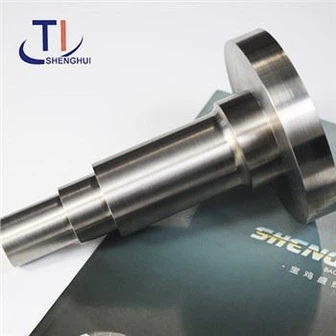
Titanium Manufacturer Tells You Forging Process Of Titanium Alloy Materials
Forging process of titanium alloy materials
Titanium forging is a forming method in which an external force is applied to a titanium billet (excluding sheet metal) to produce plastic deformation, change size, shape and improve performance, used in the manufacture of mechanical parts, workpieces, tools or billets. In addition, depending on the motion mode of the slider and the vertical and horizontal motion mode of the slider (for forging of slender parts, lubrication and cooling, and forging of high-speed production parts), the motion in other directions can be increased by the use of compensation devices.
The required forging force, process, material utilization, yield, dimensional tolerances, and lubrication and cooling methods vary according to the above methods. These factors also influence the level of automation.
According to the movement of the blank, forging can be divided into free forging, upsetting, extrusion, die forging, closed die forging and closed upsetting. Because there are no flares in closed die forging and closed upsetting forging, the material utilization rate is high. Complex forgings can be completed by one or more processes. Because there are no flares, the stress area of the forging is reduced and the required load is reduced. It should be noted, however, that whitespace cannot be completely restricted. Therefore, the volume of the blank should be strictly controlled, the relative position of the forging die should be controlled, and the forging should be measured to reduce the wear of the forging die.