

Company Profile
Baoji Shenghui Titanium Industry Co., Ltd. is located in Baoji City, which is known as "Titanium City". We are a comprehensive enterprise specializing in smelting, processing, production, sales and R&D of titanium and titanium alloys, refractory and rare non-ferrous metals.
The factory was established in 2012. At present, the company has a complete production line of titanium metal and titanium alloy materials. It has achieved independent processing accuracy and product quality. With professional control, Various bars, processing parts, forgings and deep-sea cabins of different thicknesses, varieties and specifications can be produced on a large scale.
Why Choose Us
Rich Experience
The factory is famous for its physical production, advanced technology, strong technology, excellent quality, timely delivery and high reputation.
Professional Team
An efficient management system will provide you with the best quality goods and earlier delivery. Your satisfaction is our mission.
Quality Control
In strict accordance with ISO9001:2000 quality system certification, our company has successively won high-tech enterprises, 2 national invention patents, 6 national utility model patents, and has become one of the most dynamic processing enterprises in Baoji titanium industry.
Advanced Equipment
The company has 6-ton vacuum consumable electric arc furnace, 4500-ton hydraulic press, electrode welding platform, American Haas four-axis linkage machining center, three-coordinate measuring instrument, CNC lathe, sawing machine and other processing equipment.
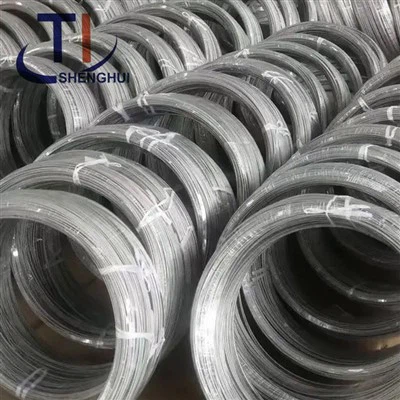


Among the many forms of titanium available, titanium wire is especially versatile and useful, finding applications in various industries, from aerospace to biomedical. This blog post will explore the properties of titanium wire, the different available grades, and the applications where people commonly use it.
Titanium wire is a high-strength, low-density metal wire available in a range of diameters, typically from 0.1mm to 10mm. The properties of titanium wire make it an attractive material for many applications, as it is incredibly strong, corrosion-resistant, biocompatible, and non-magnetic. Furthermore, Due to its low modulus of elasticity, it can be deformed with less force than other metals, making it an ideal material for forming into various shapes.
Benefits of Titanium Wire
Strength
One of the most significant properties of titanium wire is its high strength-to-weight ratio. Titanium is as strong as steel but about 45% lighter, making it an ideal material for applications where weight savings are crucial. This characteristic is particularly valuable in the aerospace, automotive, and sporting goods industries, where reducing weight without sacrificing strength can lead to improved performance and fuel efficiency.
Durability
Titanium’s durability is another key factor that makes it an attractive material. It has excellent fatigue resistance, meaning it can withstand repeated loading and unloading cycles without experiencing significant degradation. This property is essential in applications such as aircraft components, where materials are subjected to constant stress and must maintain their integrity over long periods.
Corrosion Resistance
Titanium wire is renowned for its exceptional corrosion resistance, which is superior to many other metals. This resistance is due to the formation of a stable oxide layer on the surface of the titanium when it is exposed to oxygen. This oxide layer acts as a protective barrier, preventing further oxidation and corrosion. As a result, titanium metal is highly suitable for use in harsh environments, such as marine and chemical processing applications, where other metals would quickly deteriorate.
Biocompatibility
Titanium is also biocompatible, meaning it is not harmful or toxic to living tissue. This property has led to its widespread use in the medical field, particularly in the manufacture of implants and surgical instruments. Titanium steel is used in various medical devices, including pacemaker leads, dental implants, and orthopedic implants, where its strength, durability, and compatibility with the human body are critical.
Grades of Titanium Wire
Due to its physical strength and corrosion-resistance properties, industries in the medical, aerospace, and industrial sectors widely use titanium wire. There are various grades of titanium, and they can be categorized based on their primary composition, such as Grade 1 (unalloyed titanium) or Grade 4 (“CP Ti”).



Grade 1:
Unalloyed titanium provides excellent cold working characteristics, high biocompatibility for medical implants, and superior weldability. It has an ultimate tensile strength of 100–200 MPa and an elongation rate of up to 15%.
Grade 2:
Commercially pure grade 2 titanium offers improved ductility over unalloyed grades with a corresponding decrease in strength. It also exhibits enhanced crack propagation behaviour when compared with other alloys. Its modulus of elasticity ranges from 110–140 GPa, while its ultimate tensile strength ranges from 345 MPa up to 450 MPa.
Grade 3:
This alloy combines elements such as vanadium and aluminium into commercially pure titanium, increasing yield strength and hardness values while maintaining excellent formability properties. Its ultimate tensile strength is greater than 895MPa, while its modulus of elasticity remains between 105-135 GPa depending on tempering temperature conditions used during processing.
Grade 4:
Manufacturers specifically design Grade 4 titanium wire, also known as “CP Ti,” for biomedical applications where it must consistently offer resistance against harsh environments, such as body fluids. It comes with very high levels of corrosion resistance combined with extremely good formability properties allowing it to retain shape even when exposed to extreme stress applications without exhibiting any signs of fatigue or deformation over periods found within normal medical usage scenarios. Titanium exists in various grades, and they categorize them based on their primary composition, such as Grade 1 (unalloyed titanium) or Grade 4 (“CP Ti”).
Type of Titanium Wire
Pure Titanium Eyeglass Wire
For eyeglass frames, titanium is a robust, lightweight metal that works well. In addition, titanium eyeglass wire's appealing silver tone and corrosion resistance make it a desirable material. By alloying titanium with nickel, it can also be turned into a memory metal that can bend and return to its original shape, making it the ideal material for eyeglass frames.
Titanium Coil Wire
Specially shaped wires called titanium coils are wound around a core like a wrapped helix. They are renowned for their high melting and boiling temperatures and are remarkably resilient (given their low density). Although titanium coils can be used in various settings, electrical devices are one of their most frequent applications.
Welded Titanium Wire
Welded wire made of titanium is the perfect product for demanding industrial applications. It is the ideal material for use in welding and fabrication.
Applications of Titanium Wire
Aerospace Industry
In the aerospace industry, the demand for materials that offer high strength, low weight, and excellent durability is paramount. Titanium wire meets these requirements perfectly, making it a preferred choice for various aerospace components. It is used in the manufacture of aircraft engines, airframes, and fasteners, where its ability to withstand extreme conditions and resist corrosion is crucial. The use of titanium metal contributes to the overall performance, safety, and fuel efficiency of aircraft.
Automotive Industry
The automotive industry has also embraced titanium wire for similar reasons. High-performance vehicles, including sports cars and motorcycles, benefit from titanium wire’s strength and lightweight properties. Titanium exhaust systems, valve springs, and connecting rods are some of the components where titanium wire is utilized to enhance performance and reduce weight. The durability of titanium wire ensures that these components can withstand the high stresses and temperatures associated with automotive applications.
Medical Field
As mentioned earlier, titanium wire’s biocompatibility makes it invaluable in the medical field. Orthopedic implants, such as hip and knee replacements, often incorporate titanium wire to provide structural support and ensure long-term functionality. Additionally, titanium steel is used in dental implants, where its strength and resistance to corrosion ensure the longevity and reliability of the implants. The medical industry’s reliance on titanium wire underscores its importance in improving patient outcomes and quality of life.
Marine Applications
The marine environment is notoriously harsh, with saltwater and other corrosive elements posing significant challenges to materials. Titanium wire’s exceptional corrosion resistance makes it an ideal choice for marine applications. It is used in the construction of ship components, offshore drilling equipment, and underwater cables, where its durability ensures long-term performance and reliability. The ability of titanium steel to resist corrosion in such environments reduces maintenance costs and extends the lifespan of critical marine infrastructure.
Craftsmanship Titanium Wire
The first step in titanium wire fabrication is selecting the right alloy for your application. There are many different types of titanium alloys, and the one you choose will depend on the specific requirements of your project. Some factors to consider include the alloy’s strength, ductility, and corrosion resistance, as well as its cost. Popular titanium alloys include Ti6Al4V, Ti3Al2.5V, and TiAlV.
Once you have selected your titanium alloy, you must prepare the titanium rod for wire drawing. The rod should be clean and free from defects or contamination affecting the wire’s quality. You should also check the rod’s surface finish and ensure it’s smooth and free from scratches or other imperfections.
The next step is to draw the titanium wire to your desired diameter. You will need a wire drawing machine for this process, which will pull the rod through a series of dies. Each die will progressively reduce the diameter of the wire until it reaches your desired dimension. As the wire passes through the die, it will also become stronger and more uniform in structure.
After drawing the wire to your desired diameter, it will be extremely hard and brittle. It would be best to anneal the wire to soften it and make it more ductile. Annealing involves heating the wire to a specific temperature range (usually between 700°C and 950°C) and holding it there for a set time. The exact annealing temperature and time will depend on the titanium alloy you are working with.
The final step in titanium wire fabrication is to finish the wire to your desired surface quality. You can achieve this by using a wire brush or polishing wheel to remove any surface defects or scratches. The wire should then be cleaned thoroughly to remove any dust or debris that could affect its quality.
What is the Reason For The Brittleness of Titanium Wire?
Industrial titanium has become the most widely used titanium and titanium alloy materials due to its low cost and easy production. The α-titanium alloy in industrial pure titanium is a commonly used material in aviation, marine chemical industry and other industries. Its impurity content has a great influence on its cold workability and mechanical properties of finished products. The increase of impurity content can improve the strength of titanium. reduce its plasticity. Once the impurity content is not properly controlled, the performance of titanium materials will not be guaranteed, and even titanium ingots or billets cannot be processed into materials, resulting in waste products. Therefore, in order to avoid the influence of impurity element content in titanium on its mechanical properties.
Through the chemical composition analysis, metallographic inspection, mechanical property test, fracture morphology analysis and other results of titanium wire, it can be seen that the reasons for the brittle fracture of pure titanium wire are as follows.
(1) Excessive nitrogen content, in which nitrogen comes from the production process of titanium, rather than subsequent processing, has defects in its microstructure, which eventually lead to fracture.
(2) Cracking caused by uneven microstructure and processing defects.
(3)It is suggested to strictly control impurity element nitrogen in the production of pure titanium. The nitrogen content in the raw material can be controlled to reduce the impurity elements contained in the titanium ingot. At the same time, vacuum consumables are used in the melting process to remove nitrogen. In the aspect of processing technology, it is suggested to control the deformation of drawing die, formulate reasonable annealing process of intermediate and finished products, improve the structure and prevent brittle fracture.
What's The Difference Between Titanium Wire and Titanium Welding Wire?
Titanium is a lightweight, strong, and corrosion-resistant metal that is widely used in a variety of industries, including aerospace, medical, and automotive. Two common forms of titanium used in these industries are titanium wire and titanium welding wire. While both are made of titanium, there are some key differences between the two.
Composition: Titanium wire is typically made of pure titanium or a titanium alloy, while titanium welding wire contains a filler metal that is added during the welding process.
Use: Titanium wire is used for a variety of applications, including springs, fasteners, and electrical contacts. Titanium welding wire is specifically designed for welding and is used to join two pieces of metal together.
Strength: Titanium wire is known for its high strength-to-weight ratio, but titanium welding wire's strength depends on the type of filler metal used. The strength of the weld is also influenced by the welding process and the skill of the welder.
Price: Titanium welding wire is typically more expensive than titanium wire due to the additional cost of the filler metal.
Availability: Titanium wire is widely available in a variety of shapes and sizes, while titanium welding wire is typically only available in a few standard sizes.
FAQ
We're professional titanium wire manufacturers and suppliers in China, specialized in providing high quality products with low price. We warmly welcome you to wholesale customized titanium wire made in China here from our factory. Contact us for more details.
Titanium Wire, Titanium Alloy Wire, Pure Titanium Wire