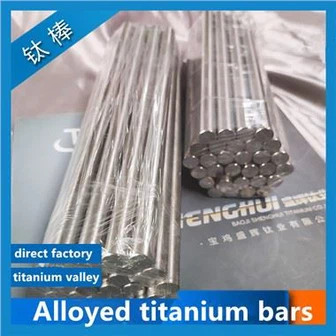
Titanium wire
Pure titanium is a silvery white metal with many excellent properties. The density of titanium is 4.54g/cm3, 43% lighter than steel, and slightly heavier than the well-known light metal magnesium. The mechanical strength is about the same as that of steel, twice as large as that of aluminum and five times as large as that of magnesium. Titanium is resistant to high temperature and its melting point is 1942K, nearly 1000K higher than gold and nearly 500K higher than steel.
Classification of titanium wire
Titanium wire is divided into: titanium wire, titanium alloy wire, titanium straight wire, pure titanium wire, titanium welding wire, pure titanium glasses wire, titanium hanger wire, titanium disk wire, titanium bright wire, medical titanium wire, titanium nickel alloy wire.
Specification of titanium wire
Titanium wire size
A. Specification of titanium wire: φ 0.8- φ 6.0mm
B. Specification of titanium wire for glasses: φ 1.0- φ 6.0mm special titanium wire
C. Specification of titanium wire: φ 0.2- φ Special for 8.0mm hanger
Main standards of titanium wire
GB/T,GJB,AWS,ASTM,AMS,JIS
Brand of titanium wire
TA0,TA1,TA2,TA3,TA4,TA5,TA6,TA7,TA9,TA10,TC1,TC2,TC3,TC4,TC6,TC11,GR1,GR2,GR3,GR5 Ti6AL4V ELI,Ti6AL7Nb,Ti13Nb13Zr,Ti1533
Status of titanium wire
Annealed state (M) hot working state (R) cold working state (Y) (annealing, ultrasonic flaw detection)
Surface of titanium wire
Pickled surface Bright surface
Use of titanium wire
Military, medical, sporting goods, glasses, earrings, headwear, electroplating pendants, welding wire and other industries.
Carburizing surface treatment of titanium wire
Titanium wire and carbon form a stable carbide with high hardness. The growth of the carbonization layer between titanium and carbon is determined by the diffusion rate of titanium in the carbonization layer.
The solubility of carbon in titanium is small, which is 0.3% in total at 850X:, and about 0.1% at 600C. Because the solubility of carbon in titanium is small, the purpose of surface hardening is basically achieved only through the titanium carbide layer and the deposition layer of the lower region. Carburizing must be carried out under the condition of deoxidization, because the hardness of the surface layer formed by the commonly used carburizing powder for steel against the surface of carbon monoxide or oxygen-containing carbon monoxide reaches 2700MPa and 8500MPa, and it is easy to peel off.
In contrast, under the conditions of deoxidation or decarburization, a thin layer of titanium carbide may be formed when carburizing in charcoal. The hardness of this layer is 32OUOMPa, which is consistent with the hardness of titanium carbide. The depth of carburized layer is roughly greater than that of nitrided layer under the same conditions. Under the condition of oxygen enrichment, the influence of oxygen absorption on the hardening depth must be considered. Only under the condition of very thin layer thickness, it is possible to form sufficient adhesion strength by infiltrating carbon powder in real air or argon-methane atmosphere. Compared with this, the use of gas carburizing agent may form a particularly hard and good adhesion titanium carbide hardened layer. With the increase of the layer thickness, the titanium carbide layer becomes brittle and tends to peel off. In order to avoid the inclusion of carbon invading the titanium carbide layer due to the decomposition of reathane, a specified amount of additive with a volume fraction of about 2% reathane should be used for gas carburization in inert gas. When propane additive is used and methane is used for carburizing, lower surface hardness will be formed. When the adhesive strength reaches to 0 kPa and gas carburized propane is used, although the measured thickness of the hardened layer is very thin, it has the best wear resistance. Hydrogen is absorbed under the condition of gas carburizing agent, but it has to be removed again during vacuum annealing.