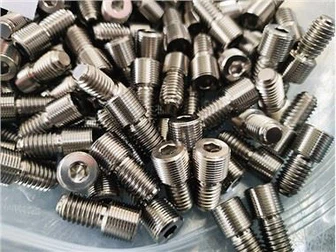
Production process of titanium rod by traditional process
The traditional process of titanium rod is to melt and cast sponge titanium into ingot, and then produce titanium rod through billet, forging and rolling. Sponge titanium is the most original material to produce titanium materials. If it is smelted, titanium ingot, the initial material for titanium processing, will be obtained.
The processing flow of titanium rod from sponge titanium to blank is as follows:
(1) Pressing electrode, pressing the sponge titanium electrode through a press to form a compact sponge titanium pressing block electrode;
(2) Vacuum melting and casting: the sponge titanium pressing block electrode is vacuum melted and cast three times at 1700-1800 ℃ and - 103 pa;
(3) Blooming: at 1000 ℃, the billet is formed into square billet by oil press;
It should be noted that the life of titanium bar is reduced due to the large pressure during blanking. Therefore, when titanium bar is forged by closed die forging, the volume of original blank must be strictly limited by closed die forging, which complicates the material preparation process. Whether to adopt closed die forging should be considered from the aspects of interest and process feasibility. During open die forging, the rough edge loss accounts for 15% - 20% of the weight of the blank. The technological waste of the clamping part (if it is necessary to reserve this part according to the die forging conditions) accounts for 10% of the weight of the blank. The relative loss of the rough edge metal usually increases with the reduction of the blank weight. For some asymmetric structures, large sectional area differences, and local forgings that are difficult to fill, the rough edge consumption can be as high as 50%. Although there is no rough edge loss in closed die forging, the blank making process is complex, More transition grooves need to be added, which will undoubtedly increase auxiliary costs.
(4) For the first rolling, the workpiece is preliminarily rolled into cylindrical shape by rolling mill at 970~980 ℃;
(5) For the second rolling, the blank is rolled by rolling mill at 950 ℃.
There are many rolling methods, which can be classified according to different characteristics. Extrusion is classified according to metal flow and deformation characteristics, including forward extrusion, reverse extrusion and special extrusion. Special extrusion includes hydrostatic extrusion, continuous extrusion, lateral extrusion, combined extrusion, composite extrusion, sheath extrusion, peeling extrusion, water seal extrusion, bitter die extrusion, powder extrusion, semi melt extrusion, liquid extrusion, etc. Extrusion is classified by temperature, including hot extrusion, warm extrusion and cold extrusion. Hot extrusion and cold extrusion are two major branches of extrusion, which are mainly used in metallurgical industry system, namely, extrusion; Application of cold extrusion in mechanical industry system; The development of warm extrusion is relatively late and its application scope is also small.
Sponge titanium → titanium electrode block → vacuum melting → titanium ingot → forging into rod germ by hydraulic press → rolling → peeling → annealing → straightening → polishing → finished product → flaw detection → packaging